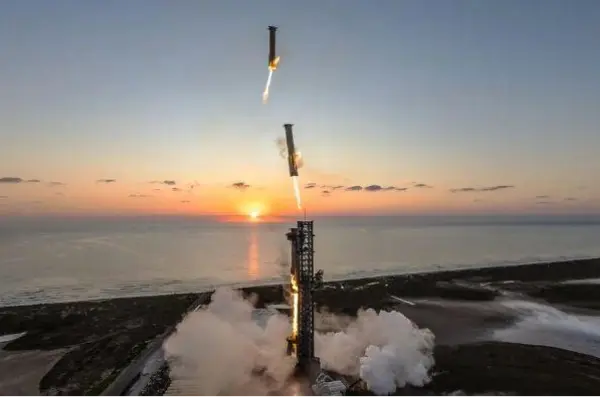
SpaceX has reached an important milestone in its effort to develop fully reusable rockets. During its 15th Starship test flight, the company successfully brought its spacecraft back to the launch tower in Texas and caught it using giant mechanical arms for the first time.
The achievement marks a significant step forward for Elon Musk's space company. However, the mission did not deliver the complete recovery SpaceX originally planned. The Super Heavy booster failed to return to the launch tower, leaving the company with further technical challenges to solve.
The November 13 and 14 mission has nevertheless provided valuable data for the future of commercial spaceflight.
A Major Step for Reusable Rocket Technology
Starship Flight 15 was designed to demonstrate that both stages of SpaceX's next-generation launch system could return to their launch site after a mission.
The system consists of two major components. Super Heavy is the powerful first-stage booster responsible for lifting the spacecraft away from Earth. Starship, also known as the upper stage, continues the journey into space and is designed to carry satellites, cargo and eventually astronauts.
SpaceX has previously demonstrated successful recovery of its Super Heavy boosters using the large mechanical arms attached to its launch tower. However, recovering the Starship spacecraft itself presented a more demanding engineering challenge.
During the latest mission, Starship returned to Earth after spending approximately 22.5 hours in space and completing 14 orbits. It reentered the atmosphere, performed its landing manoeuvre and descended toward the Starbase launch tower in South Texas.
The mechanical arms, often called chopsticks, successfully caught the spacecraft as it returned to the launch site. This was the first successful tower recovery of a Starship upper stage. You can read the official SpaceX Flight 15 mission updates for further details.
Why the Super Heavy Booster Recovery Failed
Although the spacecraft recovery was successful, the mission did not achieve its original objective of recovering both rocket stages.
The Super Heavy booster experienced a problem during its return sequence. According to SpaceX's mission updates, an early low-fuel alarm caused its boostback burn to end earlier than planned. The vehicle's guidance system then detected that it was not in the correct position for a safe tower catch.
The system automatically aborted the recovery attempt, and the booster was directed toward a controlled splashdown in the Gulf of Mexico.
This means SpaceX has demonstrated recovery of the two components in separate test flights, but it has not yet completed a successful recovery of both stages during a single mission.
The result highlights how much engineering work remains before Starship can achieve its goal of rapid and repeated reuse.
Starship Also Advances the Starlink Network
The latest flight was not only a test of rocket recovery technology. It also supported SpaceX's satellite internet business.
During the mission, Starship deployed 26 Starlink V3 satellites into orbit. These next-generation satellites are intended to expand the network's capacity and improve connectivity performance.
This is particularly important because SpaceX wants Starship to carry larger payloads into space than its existing Falcon 9 system can efficiently accommodate.
For more on the satellite internet business, readers can explore our earlier coverage of Starlink's expansion and customer verification plans in India.
Why NASA Is Watching Starship's Progress
Starship's development also has major implications for NASA.
The space agency selected a version of SpaceX's spacecraft as a Human Landing System for its Artemis lunar exploration programme. The vehicle is intended to transport astronauts from lunar orbit to the Moon's surface and back.
Before that becomes possible, SpaceX must demonstrate several critical capabilities, including reliable spacecraft operations, safe landings and the transfer of propellant between vehicles in orbit.
NASA's Human Landing System programme provides further details about the role of Starship in future lunar missions.
The latest recovery achievement is an important engineering step, but it does not mean the spacecraft is ready for crewed lunar missions. Additional testing and development remain necessary.
The Future of Commercial Spaceflight
Reusable rockets could fundamentally change the economics of accessing space. Instead of manufacturing and discarding major rocket components after every launch, companies could potentially operate vehicles multiple times with less refurbishment and lower costs.
SpaceX has already demonstrated the commercial value of partial reusability through its Falcon 9 programme. Starship represents a much more ambitious effort to extend that approach to a larger launch system and its spacecraft.
Other companies are also investing in next-generation launch vehicles. Rocket Lab, for example, is developing its Neutron rocket to compete in the growing commercial and government launch market. Readers can explore our coverage of Rocket Lab's Neutron rocket development.
For SpaceX, the latest Starship flight is both a success and a reminder of the challenges ahead. The successful spacecraft catch has demonstrated a capability the company had not achieved before, while the booster setback shows that complete recovery remains a work in progress.
As testing continues, the results could influence the future of satellite deployment, commercial space transportation and human exploration beyond Earth.
For independent reporting on the mission, see Reuters' coverage of Starship's successful return to the Texas launch pad.