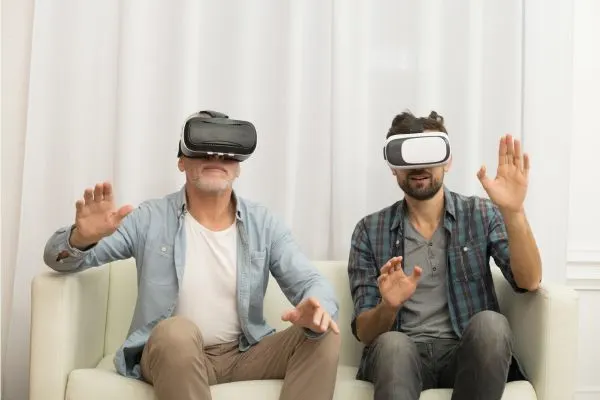
The metaverse is changing fast, and at the core of this digital shift is Extended Reality (XR). From immersive virtual reality (VR) experiences to augmented reality (AR) overlays in our everyday lives, XR technologies are opening up new avenues for how we interact, work, and have fun. As we move into 2025, experts are pointing out the 5 Best Extended Reality (XR) Technologies Shaping the Metaverse, fueling innovation and adoption across various industries.
1. Photorealistic 3D Reconstruction
Building lifelike digital environments is essential for the metaverse. Photorealistic 3D reconstruction allows developers to capture real-world settings and recreate them in a virtual space with incredible precision. Techniques like Gaussian splatting utilize advanced algorithms to efficiently render highly detailed 3D environments.
Companies such as Meta and Niantic are at the forefront of this change. Meta’s Hyperspace Capture lets users scan their rooms and objects, transforming them into interactive digital versions. Similarly, Niantic’s Scaniverse app uses comparable technology, making it simpler than ever to merge reality with the virtual world. This innovation guarantees that experiences in the metaverse are realistic, immersive, and visually stunning.
2. Smart AR and MR Glasses
Smart glasses are revolutionizing how we engage with XR content. Unlike conventional VR headsets, AR and MR glasses superimpose digital elements onto the real world, merging virtual and physical environments.
Devices like Meta’s Ray-Ban Meta Display glasses and Oakley Meta Vanguard eyewear offer users hands-free access to digital information while they navigate the real world. With built-in sensors, gesture controls, and voice commands, these glasses make interacting with the metaverse smooth and intuitive. Experts believe that wearable XR devices will be crucial for widespread metaverse adoption in the years ahead.
3. AI-Powered Content Generation
Artificial intelligence is transforming metaverse content creation. AI-powered tools can generate 3D models, textures, avatars, and even entire virtual environments in real time, making development faster and more efficient. Platforms like Meta’s Horizon Studio and NVIDIA’s Omniverse allow creators to build interactive experiences at scale.
AI-generated avatars can respond dynamically to user actions, while procedural environments adapt to interactions, creating personalized experiences. This technology reduces production costs and accelerates world-building, making the metaverse richer and more accessible for creators.
4. Haptics and Natural Interaction
Immersion goes beyond visuals—it’s also about interaction. Haptic technology provides tactile feedback, allowing users to actually “feel” virtual objects. Combined with eye tracking, gesture controls, and EMG sensors, interactions feel far more natural.
Companies like Meta are developing haptic gloves, spatial audio, and advanced motion tracking to enhance the experience. These innovations let users engage with virtual environments intuitively, boosting usability, realism, and overall immersion.
5. Interoperability and Spatial Computing
The foundation of the metaverse is solid infrastructure. Interoperability among devices and platforms, along with spatial computing, ensures smooth, consistent experiences.
Technologies like edge computing, 6G networks, and standardized protocols such as OpenXR enable low-latency, real-time interactions and seamless transitions across AR, VR, and MR environments. Accurate spatial mapping allows digital content to be precisely positioned in physical spaces, making the metaverse functional, scalable, and ready for mainstream adoption.
The Future of XR in the Metaverse
As these 5 Best Extended Reality (XR) Technologies Shaping the Metaverse continue to evolve, they promise a future where digital and physical worlds blend effortlessly. From entertainment and education to remote work and socializing, XR technologies are unlocking endless possibilities.
Companies investing in these advancements are paving the way for a truly immersive and interactive digital realm. The metaverse isn’t just a theory anymore—it’s a fast-evolving ecosystem driven by cutting-edge XR technologies. As more people adopt these tools, they will transform how we experience reality, making the metaverse a central part of our everyday lives.