RoosterBio emerged in 2013 with a clear purpose of eliminating the long-standing bottlenecks that prevented regenerative-medicine innovations from reaching patients quickly and affordably. Instead of aspiring to become another cell-therapy developer, the company positioned itself as an essential enabler — a platform that provides reliable, consistent, and scalable human mesenchymal stem/stromal cells (hMSCs) and extracellular vesicle (EV) technologies. Its goal was straightforward yet ambitious: transform stem cells from rare, expensive research materials into abundant, high-quality building blocks for global therapeutic innovation.
Solving a Systemic Problem in the Industry
Before RoosterBio arrived, developers struggled with sourcing MSCs that were both cost-effective and suitable for scale-up. Variability in quality slowed research, increased risk, and made clinical translation more complex. RoosterBio recognized that without a standardized supply chain for these foundational materials, regenerative medicine would move at a fraction of its potential. The company initiated a shift by offering consistent, off-the-shelf cellular starting materials paired with bioprocess media and protocols designed for efficiency and scalability.
Technology Designed for Speed, Quality, and Scale
RoosterBio’s platform is based on producing large-volume, well-characterized hMSCs sourced from diverse donors and tissue types. Every batch is engineered under rigorous quality controls to ensure identity, purity, performance, and safety. Instead of leaving researchers to troubleshoot expansion challenges, RoosterBio created a suite of ready-to-use media systems that support both small-scale exploratory experiments and industrial-scale bioreactor processes.
This marriage of standardized cells with optimized media and protocols allows developers to move from concept to scaled manufacturing with unprecedented speed. For teams working on gene editing, engineered cell products, or next-generation exosome therapies, RoosterBio’s tools reduce development time while increasing experimental reproducibility — a critical advantage in a field where time-to-clinic defines success.
An Impact Felt Beyond the Lab
RoosterBio’s influence moved from theoretical to practical when, in 2020, a first-in-human clinical trial used cellular starting materials supplied by the company. This milestone validated RoosterBio’s approach and demonstrated that its cGMP-compliant systems were ready for the demanding standards of human trials.
With regulatory-friendly documentation such as Master Files prepared for developer use, the company simplifies one of the most complex parts of cell therapy development: clearing regulatory hurdles with consistent and well-characterized inputs.
Strategic Collaborations That Expand Possibilities
Recognizing that scaling cell-based therapies requires more than high-quality cells, RoosterBio has built strategic collaborations with global bioprocessing leaders. A partnership with Sartorius aligned RoosterBio’s cell and media platform with cutting-edge bioreactors and upstream technologies, offering developers integrated pipelines from culture to large-scale production.
More recently, a collaboration with Thermo Fisher Scientific expanded opportunities in cell and exosome therapy manufacturing. These alliances reinforce RoosterBio’s position as an ecosystem builder rather than just a supplier — a company that accelerates the global readiness of advanced therapies by creating industrial-grade solutions.
A Foundational Role in Scientific Discovery
RoosterBio’s standardized MSCs and media systems are used across hundreds of peer-reviewed studies worldwide. From tissue-engineering breakthroughs to exosome research and preclinical gene therapy models, the company’s materials appear in a wide spectrum of scientific progress. By making high-quality stem cells accessible to researchers in academia and industry alike, RoosterBio empowers innovation at every tier — from small experimental labs to multinational pharmaceutical programs.
A Philosophy Centered on Accessibility and Scale
At its core, RoosterBio operates with a philosophy that regenerative medicine should be scalable, affordable, and globally accessible. Instead of focusing on one therapy, the company positions itself as an infrastructure provider — the behind-the-scenes system that allows others to develop, test, and commercialize advanced therapies faster. Its standardized, plug-and-play model reduces development cost, accelerates time-to-clinic, and removes barriers that have historically slowed the field.
The Quiet Force Behind the Next Wave of Therapeutics
RoosterBio’s story is not about a search for a single breakthrough drug. It is about building the industrial backbone required to support hundreds of future breakthroughs. In an era where cell therapies, tissue regeneration, and extracellular vesicles are emerging as some of the most promising medical frontiers, RoosterBio sits at the center — not as a high-profile headline maker, but as the essential engine enabling real-world progress.
By transforming stem-cell sourcing and scaling into a standardized, dependable process, RoosterBio has positioned itself as one of the most influential yet understated players in biotechnology. Its work continues to shape the landscape of regenerative medicine, pushing the entire field toward a future where advanced therapies are not just possible, but accessible to patients everywhere.
Tim Kelly: A Veteran Leader in Biologics and Gene Therapy Manufacturing
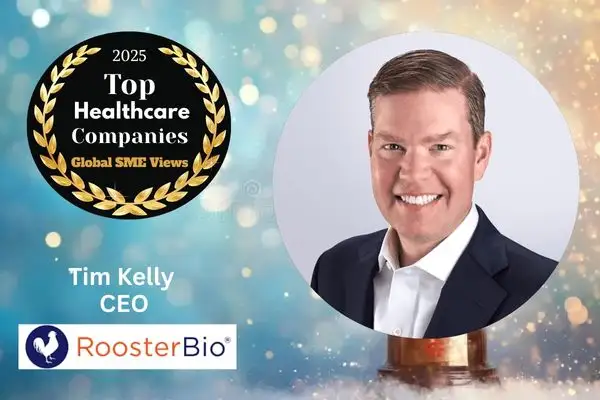
Tim Kelly, Ph.D., is the Chief Executive Officer, bringing decades of leadership in biologics and gene therapy manufacturing. Before this role, he served as President of Manufacturing at AskBio, guiding AAV gene therapy production across multiple clinical programs during the company’s landmark acquisition by Bayer.
Previously, he spent 15 years at KBI Biopharma, rising to President and CEO and steering four acquisitions while integrating Selexis SA into the organization. Over his career, he has supported the development of more than 325 biologics and numerous successful global regulatory inspections. Tim holds a Ph.D. in molecular genetics and biochemistry from Georgia State University and a bachelor’s degree in biology from the College of the Holy Cross.