How a radiologist-founded company is using specialized AI to reduce repetitive work and support more efficient medical imaging workflows
Radiology generates enormous amounts of medical information every day. Radiologists must interpret imaging studies, prepare reports and follow up on findings, often while dealing with increasing workloads.
Rad AI is building artificial intelligence specifically around these challenges.
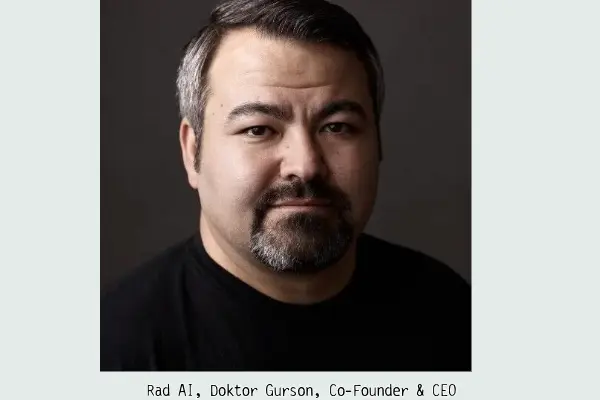
Founded in 2018 by radiologist Dr. Doktor Gurson, Rad AI develops generative AI and workflow technology designed for radiology. Its platform focuses on reporting, workflow automation and patient follow-up.
AI Built Specifically for Radiology
Rather than developing a general-purpose healthcare AI system, Rad AI has focused its technology on radiology.
The company says its proprietary generative AI models are trained specifically for radiology and healthcare, using a large proprietary dataset of radiology reports.
Its platform currently includes products such as Rad AI Reporting, Rad AI Impressions and Rad AI Continuity, each addressing a different part of the radiology workflow.
This specialty-focused approach is central to the company's strategy. The goal is to make AI work within existing radiology workflows rather than requiring physicians to completely change how they practice.
Reducing Repetitive Reporting Work
One of Rad AI's earliest products, Rad AI Impressions, uses generative AI to help produce the impression section of radiology reports.
The system is designed to learn an individual radiologist's voice and phrasing, helping generate personalized report language rather than relying entirely on generic templates.
Rad AI Reporting takes the concept further by using AI throughout the reporting process. The company describes it as an AI-first, cloud-native reporting platform designed to reduce cognitive load while supporting real-time speech, reporting and quality checks.
The company reports that at ARA Health Specialists, implementation of Rad AI Reporting reduced median report time by 20%, although these results are from a specific customer deployment and should not be treated as a universal outcome.
Closing the Loop on Patient Follow-Up
Rad AI's technology also addresses what happens after a radiology report is completed.
Its Rad AI Continuity platform is designed to track actionable findings and help ensure that recommended follow-up occurs.
The company says the system monitors more than 50 categories of actionable incidental findings and can coordinate communication with providers and patients.
In its 2025 Series C announcement, Rad AI reported that its technology had increased follow-up rates at certain health systems from around 30% to 75% or more. These figures are company-reported and relate to specific deployments.
Growing Adoption
Rad AI has expanded significantly since its founding.
The company says its technology is now used by more than 40% of U.S. health systems and nine of the ten largest U.S. radiology practices. It also says its models have been trained on nearly one billion radiology reports.
In 2025, four major health systems, Advocate Health, Memorial Hermann Health System, Corewell Health and Atlantic Health System, made strategic investments in Rad AI. The additional $8 million brought the company's Series C total to $68 million.
The company had previously raised a $60 million Series C round in January 2025, led by Transformation Capital.
Specialized AI for a Specialized Workflow
Rad AI's development reflects a broader trend in healthcare technology: instead of using general AI for every problem, companies are increasingly building specialized systems around individual clinical workflows.
Radiology is particularly suited to this approach because the field combines large volumes of structured and unstructured information with highly repetitive documentation processes.
By focusing specifically on radiology, Rad AI is attempting to make generative AI useful at multiple stages of the workflow, from report creation to quality checks and patient follow-up.
Editorial Note: Global SME Views selected Rad AI for this editorial spotlight based on its work at the intersection of generative artificial intelligence, medical technology, radiology and healthcare workflow innovation.