Flatiron Health was founded in 2012 with a mission that is both ambitious and deeply human: to improve and extend lives by learning from the experience of every person with cancer. The company was built on the belief that the everyday realities of cancer care—treatment decisions, clinical notes, imaging results, biomarker reports, and patient outcomes—hold immense scientific value. Headquartered in New York, Flatiron has since evolved into a global leader in oncology technology and real-world evidence, partnering with clinicians, life-science companies, researchers and regulators in multiple countries.
Building Technology That Makes Clinical Care Smarter
From its inception, Flatiron focused on solving a critical challenge in oncology: the disconnect between daily patient care and long-term research insights. This effort materialized in the form of OncoEMR®, an oncology-specific electronic medical record system designed to minimize administrative burdens and give doctors time back with their patients. OncoEMR was built with oncology workflows at the center, allowing clinicians to document treatment plans, track disease progression, access historical records and coordinate care with greater precision.
The company later expanded these capabilities with OncoAir®, a mobile-first solution that gives clinicians secure access to patient information wherever they are. What makes Flatiron’s platforms stand out is the subtle but powerful integration of research capabilities into everyday clinical software. Disease-specific templates, structured data fields, trial-eligibility modules and research dashboards allow patient encounters to generate rich, standardized data without adding extra burdens to care teams. This ecosystem effectively fuses patient care and scientific discovery.
Turning Routine Care Into Research-Ready Data
Parallel to its clinical software, Flatiron built an extraordinary real-world oncology dataset. The company collects and curates de-identified patient information from community practices, academic medical centres and global research partners. What begins as a mix of structured and unstructured information—lab reports, clinician notes, genomic profiles and treatment timelines—is transformed through a blend of expert clinical abstraction and machine-learning models into research-ready data.
The result is one of the world’s largest and most rigorous repositories of real-world oncology evidence. These datasets allow researchers to understand how cancer is treated outside controlled clinical trials, identify emerging trends, evaluate the effectiveness and safety of therapies and generate evidence that can complement traditional research methods.
Becoming an Essential Partner to the Life-Sciences Industry
For pharmaceutical and biotech organisations, Flatiron has become indispensable. Its Flatiron Horizon suite provides everything from data access to study design, analytics, evidence generation, and regulatory-ready reporting. This end-to-end approach means that companies can support discovery, trial planning, post-approval research, and comparative-effectiveness studies using a single integrated data ecosystem.
Over the years, Flatiron has helped accelerate research across many cancer types and treatment modalities. By 2024, it reached a milestone of more than 1,000 scientific publications based on its de-identified datasets. These publications have appeared in leading journals and at the world’s most important oncology conferences, influencing guidelines, real-world understanding, and regulatory decisions. For many organisations, Flatiron has become a “learning engine,” offering scientific agility at a time when oncology innovation is moving faster than ever.
Expanding a Global Network for Multinational Evidence
Flatiron’s vision has never been limited to the United States. In recent years, the company expanded aggressively into Europe and Asia, partnering with cancer centers in the UK, Germany, Japan and other regions. These relationships enable the creation of harmonised datasets across geographies, giving researchers the ability to compare treatment patterns, assess outcomes and generate evidence reflective of diverse patient populations.
This global network represents a powerful shift in real-world oncology research. Instead of fragmented silos, data flows into a multinational framework that supports broader studies, cross-border collaborations and more inclusive scientific insights.
Using AI to Unlock the Future of Real-World Evidence
Flatiron’s next era is being shaped by advanced artificial intelligence. One of the greatest challenges in oncology research has been capturing disease progression at scale, particularly because progression events are described narratively in physician notes. Flatiron’s newly developed AI models can identify and extract progression events across large patient populations with speed and consistency. This innovation opens the door to more precise survival analyses, real-time monitoring and predictive modelling that were previously impossible at this scale.
With AI-driven abstraction, the company is moving beyond describing what happened in oncology care. It is beginning to uncover why decisions were made and, eventually, what outcomes might be predicted before they occur. This transformation signals a future where real-world evidence becomes even more actionable.
Navigating the Challenges of Data, Privacy and Trust
Flatiron works with highly sensitive clinical information, and the responsibility is immense. Maintaining trust with patients, providers, and global partners requires world-class data governance, stringent de-identification protocols, and clarity about how data is used. As real-world evidence becomes increasingly important to regulatory bodies, maintaining scientific transparency, methodological rigor and reproducibility remains essential.
Another challenge lies in adoption across different healthcare systems. Integrating Flatiron’s tools into hospitals with diverse workflows, technology infrastructure and regulatory frameworks requires significant collaboration and regional customization. Yet these complexities underscore the global importance of what Flatiron is building.
A Company Quietly Reshaping Oncology Research
Flatiron Health operates outside the typical Silicon Valley spotlight, yet its impact is profound. By connecting the worlds of routine clinical care and high-level cancer research, the company is redefining how evidence is generated, shared and applied. Its technology helps oncologists deliver better care, its datasets fuel faster scientific discoveries, and its global expansion ensures more equitable representation in research.
For a magazine like Success Knocks, Flatiron represents a powerful story of innovation, mission-driven leadership and quiet global influence. Through the combination of data, empathy and scientific rigor, it is helping the world learn from every cancer journey—and bringing the promise of better outcomes within reach for millions.
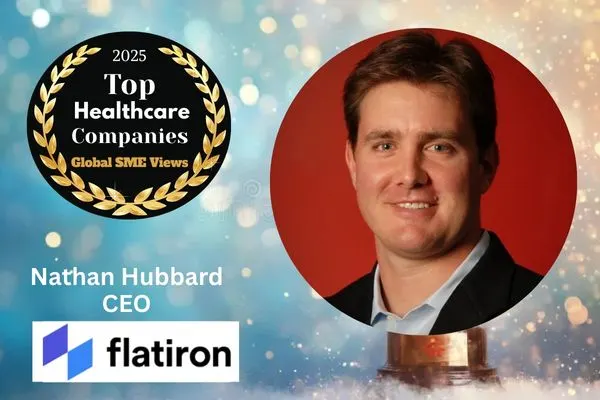
Nathan Hubbard, Chief Executive Officer
Nathan Hubbard serves as the Chief Executive Officer of Flatiron Health, where he leads the company’s global evidence and point-of-care businesses along with all corporate functions. He previously guided Flatiron’s commercial strategy as Chief Business Officer, overseeing the Evidence business, corporate development, strategic planning and the growth of the company’s international operations.
Nathan joined Flatiron in 2020, bringing two decades of experience in oncology and neuroscience across business development and commercial leadership roles in the United States, Canada and China. Before Flatiron, he served as the global head of healthcare ecosystems at Roche Pharmaceuticals, where he built personalized healthcare partnerships across more than ten countries, and earlier worked as director of data and digital partnering.
He earned his bachelor’s degree in economics—with minors in English literature and psychology—from DePauw University, and later completed his MBA at Stanford University.
“We provide solutions across the industry to learn from and improve every person’s experience with cancer.”