In the rapidly expanding universe of artificial intelligence, text-based LLMs and generative image models dominated the initial headlines. Yet quietly behind the scenes, a far more challenging frontier remained largely unsolved: human emotion in sound. For years, synthetic voices suffered from a robotic monotonicity—lacking the subtle pauses, emotional cadence, micro-inflections, and contextual warmth that define human speech.
That boundary officially collapsed with the rise of ElevenLabs.
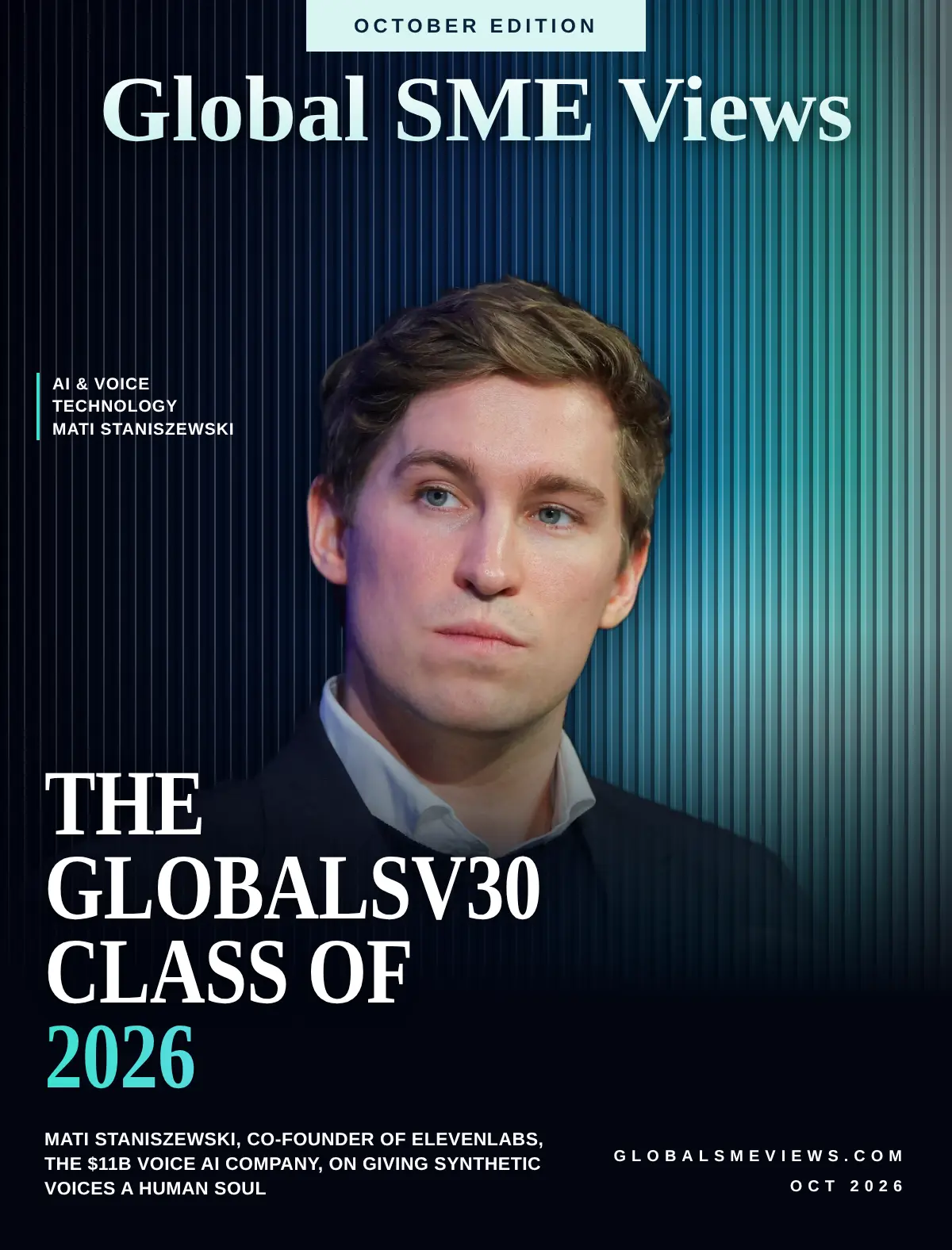
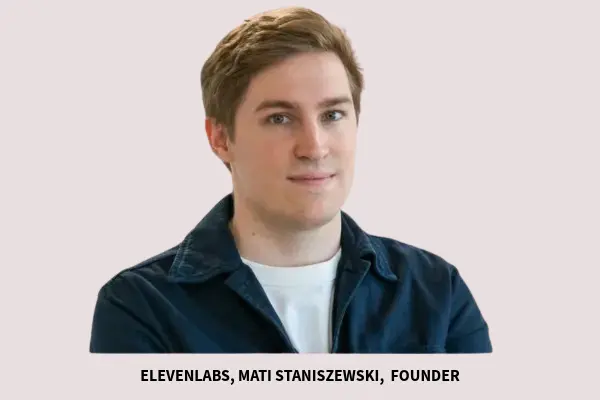
Co-founded in 2022 by childhood friends Mati Staniszewski and Piotr Dabkowski, ElevenLabs has achieved what once seemed computationally impossible: creating hyper-realistic, emotion-driven audio generation capable of matching the depth and nuance of human vocal performance. Today, valued at a staggering $11 billion, ElevenLabs stands as one of the premier AI unicorns anchoring The GlobalSV30 Class of 2026, fundamentally rewriting how global media, entertainment, publishing, and enterprise software interact with sound.
The Genesis: Dubbing Nostalgia and Engineering Precision
The origin story of ElevenLabs is rooted in a distinctly international problem. Growing up in Poland, Mati Staniszewski and Piotr Dabkowski spent their youth watching Hollywood blockbusters dubbed into Polish by a single male voiceover artist reading every character's dialogue. The experience was functional, but devoid of emotional resonance.
Years later, while advancing their careers in the heart of the global technology ecosystem—Staniszewski as an expert operational analyst at Palantir and Dabkowski as a machine learning engineer at Google—the duo realized that deep learning models could solve the localization bottleneck once and for all.
"We realized that language barriers were holding back human connection and storytelling on a massive scale," Staniszewski reflects. "If you could preserve a speaker's natural tone, emotional inflection, and identity across every language on Earth simultaneously, you wouldn't just fix video dubbing—you would unlock an entirely new medium of human expression."
Armed with deep mathematical expertise and a relentless commitment to latency reduction, the duo built ElevenLabs' core generative audio architecture. Rather than relying on traditional concatenative speech synthesis—which stitched together pre-recorded audio fragments—they engineered a proprietary deep-learning model capable of understanding emotional context within written prose, generating pitch, breath, rhythm, and cadence in real-time.
The Enterprise Explosion: From Audiobooks to Global Localization
When ElevenLabs debuted its platform, adoption was immediate and explosive. Independent authors and global publishing houses utilized the platform to produce studio-grade audiobooks at a fraction of legacy studio budgets. Gaming studios integrated the technology to generate thousands of unique non-player character (NPC) voices on the fly, transforming interactive entertainment.
However, the true commercial enterprise breakthrough arrived with the release of their end-to-end AI dubbing and voice-cloning architecture. Capable of translating spoken video content into over 30 languages while preserving the original speaker's voice characteristics and timing, ElevenLabs opened unprecedented international revenue streams for media conglomerates, educational institutions, and corporate enterprise training networks.
By prioritizing ethical deployment, ElevenLabs introduced rigorous voice authentication protocols, proactive digital watermarking, and an opt-in licensing ecosystem where voice actors can monetize their digital voice clones safely. This commitment to security secured deep institutional trust, leading to massive funding rounds backed by tier-one venture capital firms including Andreessen Horowitz, Nat Friedman, and Daniel Gross.
Looking Ahead: The Conversational Voice Interface
As artificial intelligence transitions from static search windows into real-time conversational agents, ElevenLabs is spearheading the interface shift. Their ultra-low-latency conversational AI engine allows software applications to speak, listen, and respond with zero perceptible delay, establishing the foundational voice layer for autonomous customer service avatars, interactive tutoring applications, and accessibility tools for the visually impaired.
In an era where technology often feels cold and transactional, ElevenLabs has accomplished the unthinkable: bringing true human empathy, resonance, and soul into synthetic sound. As a crown jewel of The GlobalSV30 Class of 2026, ElevenLabs proves that when deep technical rigor meets a clear human vision, multi-billion-dollar categories are born.
Frequently Asked Questions (FAQs)
Q. Who founded ElevenLabs and when was it established?
ElevenLabs was co-founded in 2022 by Mati Staniszewski (former Palantir analyst) and Piotr Dabkowski (former Google ML engineer).
Q. What is ElevenLabs' valuation in 2026?
ElevenLabs has reached a monumental $11 billion valuation, cementing its position as a leading global Voice AI unicorn.
Q. What makes ElevenLabs' technology different from traditional text-to-speech?
Unlike legacy systems that sound robotic, ElevenLabs uses proprietary contextual AI models that automatically interpret emotion, cadence, pacing, and human vocal inflections directly from text inputs.
Q. How does ElevenLabs address copyright and ethical voice cloning?
ElevenLabs enforces strict voice verification safeguards, incorporates unalterable AI audio watermarking, and operates a voice library marketplace where voice talent can ethically license and monetize their digital voice profiles.
Q. Why is ElevenLabs featured in the GlobalSV30 Class of 2026?
ElevenLabs represents the gold standard of global deep-tech innovation, demonstrating how generative AI can transform localization, accessibility, entertainment, and real-time enterprise voice interfaces on a global scale.