In the heart of Menlo Park, California, a fast-rising molecular diagnostics company is quietly reshaping what modern healthcare can look like. BillionToOne, founded on a simple but radical mission—to make precision diagnostics accessible to all—has emerged as one of the most innovative players in prenatal and oncology testing. Their core belief is that every person deserves clear, accurate, and affordable genetic information. Their work reflects a larger shift in medicine, one that moves away from invasive procedures and uncertainty and toward early detection powered by molecular clarity.
At the center of BillionToOne’s approach is an advanced molecular-counting technology called Quantitative Counting Templates (QCT). Unlike traditional sequencing methods that approximate the amount of circulating DNA, QCT counts individual molecules with single-base accuracy. This granular precision allows the company to detect extremely rare DNA fragments in a simple blood sample. The name “BillionToOne” itself is a reference to this ambition—the ability to find the one crucial disease-related molecule among the billions of base pairs that make up the human genome.
This breakthrough has enabled BillionToOne to build two strong product lines: prenatal screening and liquid biopsy-based cancer diagnostics. The company first gained national attention through its prenatal test, UNITY Fetal Risk Screen.
This test provides expecting parents with an accurate, non-invasive way to screen for chromosomal abnormalities and a wide spectrum of recessively inherited conditions. UNITY became a transformative option because it requires only a maternal blood sample.
Unlike traditional carrier screening workflows, it does not require a paternal sample to assess fetal risk for serious genetic conditions such as cystic fibrosis, spinal muscular atrophy, or sickle cell disease. This single feature removed a long-standing barrier in prenatal care, especially for patients for whom obtaining a partner sample is difficult or impossible.
The impact of UNITY has been enormous. The company has surpassed one million prenatal tests performed, signaling rapid adoption across clinics and major healthcare networks. Continuous expansion of the UNITY panel has strengthened its relevance. By 2025, the test could screen for up to fourteen conditions, giving clinicians and families more comprehensive information early in pregnancy. For many patients, this kind of insight provides clarity, preparedness, and peace of mind at a critical moment in their lives.
While prenatal screening served as the company’s entry point, BillionToOne has simultaneously been making strides in oncology with its Northstar platform. Northstar Select, used for tumor profiling, and Northstar Response, designed for treatment monitoring, leverage the same QCT technology to analyze circulating tumor DNA.
These tests offer oncologists a clearer picture of the genetic mutations driving a patient’s cancer as well as real-time signals of how tumors are responding to therapy. Early data from the company has suggested that Northstar may detect more clinically relevant variants than some competing assays, particularly in identifying low-abundance mutations that often go unnoticed.
The ability to detect signs of relapse or therapeutic resistance earlier than imaging could make a life-changing difference for cancer patients, enabling physicians to adjust treatments sooner and more effectively.
BillionToOne’s rapid scientific progress has been matched by commercial momentum. The company has secured strong investor confidence, raising significant capital in recent years, including a large Series D that pushed its valuation above the billion-dollar mark. Its financial growth has been equally striking, with revenue more than doubling year over year.
The expanding customer base, increased test volume, and broader insurance coverage have contributed to this trajectory. The company now employs hundreds of people and continues to scale its laboratories and commercial operations to meet growing demand.
What makes BillionToOne stand out in the crowded diagnostics landscape is its ability to combine scientific rigor with a strong sense of purpose. Its leadership consistently frames its work not just in terms of technological achievement but in the context of real, measurable impact on patients. They aim to build tests that both match and exceed the accuracy of legacy diagnostics while reducing cost and increasing availability.
In a field where many advanced tests remain expensive and inaccessible, this emphasis on democratizing precision care sets the company apart.
Like any ambitious biotechnology company, BillionToOne faces challenges. Scaling advanced molecular diagnostics requires rigorous quality control, automation, and regulatory compliance.
Competition in cell-free DNA-based testing continues to intensify, especially in oncology, where numerous companies are pursuing the promise of liquid biopsies. Success will depend on the strength of clinical data, physician education, long-term outcomes, and the ability to secure reimbursement across diverse healthcare systems. Still, the company’s rapid adoption suggests it is well-positioned to meet these hurdles with confidence.
The broader significance of BillionToOne’s work lies in how it reframes the role of diagnostics in medicine. Instead of waiting for symptoms or relying on invasive procedures, clinicians can now access highly accurate molecular information from a simple blood draw.
For expectant parents, this means earlier and more comprehensive insights into their baby’s health. For cancer patients, it means the possibility of earlier detection, more precise therapy selection, and better monitoring throughout treatment. In both areas, the result is the same: more informed decisions and improved outcomes.
In less than a decade, BillionToOne has grown from a promising startup into a leader in precision diagnostics. Their vision of harnessing single-molecule technology for real-world healthcare continues to influence how medicine evolves. By bringing clarity where there was once uncertainty, the company is pushing the boundaries of what diagnostics can achieve and moving the healthcare system closer to a future defined by accessibility, accuracy, and personalized care.
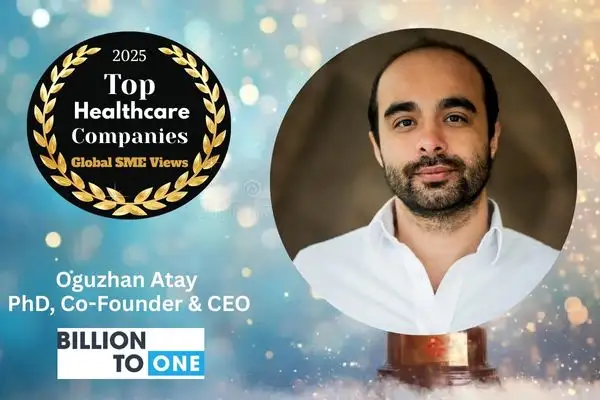
Oguzhan Atay, PhD, Co-Founder, CEO, and Board Chair
Oguzhan Atay, one of BillionToOne’s co-founders, is driven by the belief that diagnostics become far more powerful, precise, and accessible when designed with true quantitative engineering. He played a central role in creating the company’s proprietary molecular counting platform and has led BillionToOne from day one, guiding its scientific vision, commercial strategy, and rapid growth.
Under his leadership, the company has secured more than $200 million in funding from top-tier venture capital firms and investors known for backing transformative companies such as SpaceX, Spotify, Palantir, Box, and notable biotech innovators including Counsyl, WebMD, and Omada Health.
Oguzhan earned his PhD from Stanford University, where his research was featured on the cover of Cell Systems. He graduated summa cum laude and was elected to Phi Beta Kappa at Princeton University, completing a bachelor’s degree in molecular biology along with minors in physics, computer science, and applied mathematics.
“Our mission is to provide more intelligent healthcare for all with single-molecule diagnostics.”