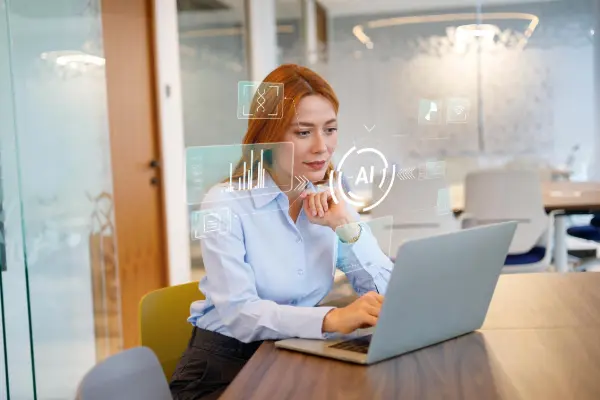
Artificial intelligence is changing the way businesses work.
For large companies, AI can mean advanced analytics, automation, and large-scale technology systems. For a small business, however, its value can be much more practical.
A woman running an online store can use AI to understand customer behaviour. A consultant can use it to organise research. A founder can explore new ideas, analyse market information, create initial marketing content, or automate repetitive administrative tasks.
The technology is not creating a completely new form of entrepreneurship. Instead, it is changing how entrepreneurs approach many of the tasks that already come with running a business.
That shift could be particularly important for women entrepreneurs, many of whom operate small businesses or work with relatively lean teams.
The latest GEM 2025/2026 Global Report identifies a growing global AI readiness gap between entrepreneurs with access to and confidence in artificial intelligence and those who are less prepared to use it.
For women entrepreneurs, the opportunity is significant, but so is the need to develop the skills and confidence to use these tools effectively.
1. AI Is Becoming More Accessible to Small Businesses
AI was once associated primarily with large technology companies and businesses with significant budgets.
That is changing.
Today, many AI-powered tools are available to small businesses and individual entrepreneurs. They can assist with writing, research, data analysis, customer communication, scheduling, design, translation, and other routine activities.
For a small business, even saving a few hours each week can matter.
A founder who previously spent an afternoon preparing research or organising customer information may now be able to complete the initial work much faster.
That does not mean every task should be handed over to AI.
The entrepreneur still needs to check information, make decisions, understand customers, and take responsibility for the final result.
The real advantage comes from knowing where AI can save time without compromising quality.
2. AI Can Help Women Entrepreneurs Do More With Smaller Teams
One of the most practical benefits of AI is its ability to support lean operations.
A small company may not have separate employees for marketing, research, customer support, data analysis, and administration.
The founder may be handling several of these responsibilities herself.
AI can provide support across some of these areas.
For example, an entrepreneur launching a new product could use AI to help organise market research, identify questions to investigate, develop early customer personas, prepare draft marketing ideas, and analyse feedback.
The founder remains responsible for the strategy, but the technology can reduce the amount of repetitive work involved.
For women entrepreneurs building businesses with limited resources, that can make technology more than a convenience. It can become a way to increase capacity.
3. AI Is Changing Marketing and Customer Service
Marketing is another area where AI is already making an impact.
Small businesses need to produce content regularly, understand their audience, respond to customers, and test different ways of communicating their value.
AI can help entrepreneurs brainstorm content ideas, organise campaigns, analyse customer feedback, and prepare initial marketing materials.
It can also support routine customer service by helping businesses answer common questions, provide product information, and manage simple requests.
However, there is an important difference between using AI to support a business and allowing AI to define the entire customer experience.
Customers still respond to authenticity.
The strongest approach is likely to combine AI's speed with the founder's knowledge of the customer.
AI can help create possibilities. The entrepreneur decides which ones actually make sense.
4. AI Can Help Entrepreneurs Explore New Markets
One of the less obvious opportunities is market expansion.
A business that previously focused on one local audience can potentially use digital tools to research new markets, understand customer preferences, translate basic communications, and explore opportunities in other regions.
For women entrepreneurs, this could make international expansion easier to investigate before making a major investment.
An entrepreneur considering a new market can use AI as part of the early research process to explore competitors, customer behaviour, language, regulations, and market positioning.
But AI-generated research should always be verified.
Markets are influenced by local laws, culture, economic conditions, and consumer behaviour. AI can help organise information, but it should not be treated as the final authority on an unfamiliar market.
5. The AI Skills Gap Still Matters
The growth of AI does not mean every entrepreneur has the same opportunity to benefit from it.
Access to reliable technology, digital skills, training, infrastructure, and professional support varies significantly between countries and communities.
The latest GEM women's entrepreneurship research found that women were 11% less likely than men to see the benefits of AI for their businesses. Women were also less than half as likely as men to be active in the ICT sector.
This suggests that the issue is not simply whether women see value in AI.
It is also whether they have the opportunity, skills, confidence, and resources to use it.
As AI becomes more common in business, practical AI education could become increasingly important for entrepreneurs, business networks, universities, accelerators, and other support organisations.
6. Human Skills Still Matter
There is a common assumption that AI will make human skills less important.
For entrepreneurs, the opposite may be true.
As AI makes certain tasks easier to automate, qualities such as creativity, communication, leadership, relationship-building, empathy, critical thinking, and decision-making can become even more valuable.
Customers do not build long-term relationships with a business simply because it uses sophisticated technology.
They connect with people, ideas, experiences, and brands they trust.
A successful woman entrepreneur may therefore use AI extensively behind the scenes while keeping the customer-facing experience distinctly human.
What AI Could Mean for the Future of Women Entrepreneurship
AI is still developing, and its impact on entrepreneurship will continue to change.
For women entrepreneurs, however, the direction is already becoming clearer.
AI can help small teams operate more efficiently. It can make research and marketing more accessible. It can support customer service, help entrepreneurs explore new markets, and reduce the amount of time spent on repetitive work.
At the same time, there are important questions around digital access, skills, privacy, accuracy, and responsible use.
The goal should not be to use AI simply because it is available.
The goal should be to identify where it genuinely improves the business.
That could mean automating a repetitive task, understanding customers more effectively, entering a new market, improving a product, or giving a small team more time to focus on work that requires human judgment.
Final Thoughts
AI is not replacing entrepreneurship. It is changing the tools entrepreneurs have available to build and grow businesses.
For women entrepreneurs, that change could be significant.
A founder working with a small team can now access technologies that were once available mainly to larger organisations. That creates an opportunity to work more efficiently, experiment faster, and reach customers in new ways.
But technology alone will not determine who succeeds.
The entrepreneurs who benefit most from AI will likely be those who combine digital skills with strong business judgment, customer understanding, creativity, and a clear sense of purpose.
The future of women entrepreneurship may not be about choosing between human expertise and artificial intelligence.
It may be about learning how to use both together.